Address
304 North Cardinal
St. Dorchester Center, MA 02124
Work Hours
Monday to Friday: 7AM - 7PM
Weekend: 10AM - 5PM
Address
304 North Cardinal
St. Dorchester Center, MA 02124
Work Hours
Monday to Friday: 7AM - 7PM
Weekend: 10AM - 5PM
A 6 inch bagasse plate is best suited to desserts, fruit and small snacks. A 7 inch plate provides more room for appetizers, breakfast and light meals, while an 8 inch plate can accommodate many standard lunch portions with a main food and several sides.
However, the number printed in the product name does not describe the entire usable serving area. The plate rim, inner base, depth and food shape all affect how much food can actually fit.
For cafés, catering companies, restaurants and food-packaging distributors, choosing the right plate size helps improve portion presentation, reduce unnecessary packaging and prevent food from becoming crowded or difficult to carry.
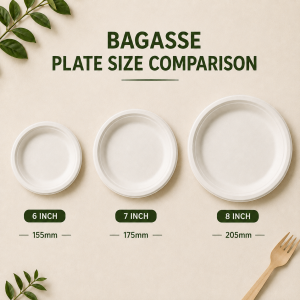
Karde’s round bagasse plate range includes three practical sizes for different food-service requirements.
| Plate size | Actual diameter | Plate depth | Recommended application |
|---|---|---|---|
| 6 inch | 155mm | 12.5mm | Desserts, cake, fruit, snacks and samples |
| 7 inch | 175mm | 15.8mm | Appetizers, breakfast, sandwiches and light meals |
| 8 inch | 205mm | 16mm | Lunch portions, rice, pasta and complete meals |
These dimensions describe the outside diameter and overall depth of the products. The flat area available for food will be smaller because part of the plate is used by the raised rim.
Food shape is also important. A flat cake slice may fit comfortably on a small plate, while the same plate may feel crowded when holding a sandwich, salad and fruit together.
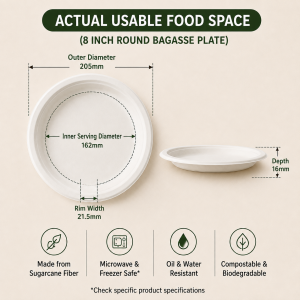
A plate listed as 8 inches is measured across its widest outer edge. This is known as the nominal or outside diameter.
The actual serving area is the flatter section inside the rim. Because every plate requires an edge for strength, handling and food containment, the usable surface is always smaller than the complete outside measurement.
Three structural details influence the available space.
The outer diameter gives buyers a general indication of the plate size and helps compare one product with another. It also affects carton size, table space and the amount of room required for stacking.
The inner area is where food is placed. A wider rim may reduce the usable surface even when two plates have the same outer diameter.
This is why buyers should not select a plate only from its nominal size. Samples should be tested using real menu portions before a bulk order is confirmed.
A deeper plate provides slightly more control for food with moisture, dressing or a small amount of sauce. A shallow plate is often more suitable for dry desserts, pastries and snacks.
The 6 inch plate has a depth of approximately 12.5mm, while the 7 inch and 8 inch products are approximately 15.8mm and 16mm deep. These are still plates rather than bowls, so they are not intended for soup or large quantities of liquid.
A 6 inch bagasse plate is a compact option for small food portions. Its 155mm diameter works well when the food itself is relatively small and does not require several separate serving areas.
Suitable foods include:
The 6 inch size is particularly practical for bakeries, cafés, wedding dessert tables, coffee breaks and tasting events.
A small dessert can look lost on a large plate. Placing it on a properly sized 6 inch plate creates a more balanced presentation and avoids using more material and table space than necessary.
However, this size is generally too small for a full rice meal or a combination containing a main food, vegetables and several side dishes. The food may cover the rim, making the plate harder to carry.
A 7 inch bagasse plate provides a useful middle size between dessert service and full-meal service.
With an outer diameter of approximately 175mm, it offers more serving space than the 6 inch plate without taking up as much room as an 8 inch product.
Typical applications include:
A sandwich that feels crowded on a 6 inch plate may fit more naturally on a 7 inch plate, with enough room for tomatoes, fruit or a small salad.
This size can also help catering businesses control portions during buffet service. Guests can select several items without loading an unnecessarily large plate.
The 7 inch plate may be sufficient for a light lunch, but it can become crowded when the menu includes rice, meat and vegetables together. In that case, an 8 inch plate is usually more practical.
An 8 inch bagasse plate provides the most serving space among the three sizes. Its actual outer diameter is approximately 205mm, with a depth of around 16mm.
It can accommodate many standard meal combinations, including:
The wider surface makes it easier to separate different food components instead of stacking everything in the center. This can improve presentation and help prevent sauces or flavors from mixing too quickly.
An 8 inch plate is a practical option for restaurants, corporate catering, food-service distributors and events serving complete individual meals.
It is still important not to overload the plate. Large portions with heavy sauces may require a deeper tray, bowl or compartment plate rather than a standard round plate.
One of the most reliable ways to compare bagasse plate sizes is to place exactly the same food portion on all three products.
Consider a sandwich with salad, tomatoes and fruit.
On a 6 inch plate, the food may cover most of the inner surface. The presentation looks compact, but there is limited room for additional sides or comfortable handling.
On a 7 inch plate, the same portion looks more balanced. The sandwich and side items can be arranged clearly while leaving some open space around the food.
On an 8 inch plate, the meal has more room and may accommodate an additional side. However, a small portion could also appear less substantial if too much of the plate remains empty.
This comparison shows why the largest plate is not automatically the best choice. The ideal size is the one that gives the food enough space without making the portion look undersized.
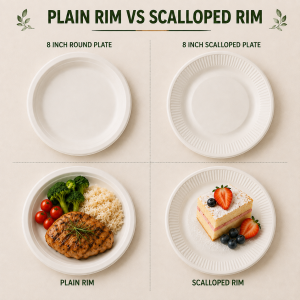
In addition to size, the rim design changes the visual character of a disposable plate.
A standard round-rim bagasse plate has a clean and simple appearance. It works well for everyday catering, cafeterias, restaurants, buffets and general food-service use.
A ridged or decorative-rim bagasse plate has repeated lines around the outside edge. This design adds texture and can make the plate look more distinctive for desserts, weddings, celebrations and event catering.
The decorative pattern mainly changes presentation. Buyers should still compare the actual diameter, inner serving area and depth of each model because two plates with similar outer dimensions may not provide exactly the same usable surface.
For high-volume everyday service, the plain round design may be easier to standardize. For cake, pastries and special-event presentation, the ridged rim can provide a more decorative appearance without adding printed graphics.
Different businesses may need different combinations rather than one universal plate.
| Business type | Recommended sizes |
|---|---|
| Bakery or café | 6 inch for cake, pastries and snacks |
| Breakfast service | 7 inch for bread, fruit and light combinations |
| Wedding catering | 6 inch for desserts and 8 inch for main meals |
| Buffet service | 7 and 8 inch for different courses |
| Restaurant light meals | 7 inch for compact servings |
| Lunch catering | 8 inch for complete meal portions |
| Packaging distributor | 6, 7 and 8 inch to cover multiple customer needs |
For catering companies that serve both dessert and lunch, stocking 6 inch and 8 inch plates may be more practical than trying to use one size for every course.
A 7 inch plate is useful when the customer base includes cafés, breakfast suppliers and businesses offering smaller portions.
Before ordering bagasse plates in bulk, buyers should evaluate more than the diameter.
Start with the real menu. Place the normal serving portion on a sample plate and check whether the food remains inside the rim without appearing crowded.
Consider whether customers will eat while seated or standing. A plate used at a standing reception should leave enough rim space for secure handling.
Check whether the food is dry, oily or covered with sauce. Standard plates can hold many meals, but foods with a high liquid content may require a deeper container.
Buyers should also compare:
Testing several samples with actual foods is more reliable than selecting a size from the product name alone.
A 6 inch bagasse plate is commonly used for cake, desserts, pastries, fruit, snacks, samples and small appetizers.
A 7 inch plate may be suitable for a light lunch, sandwich or small meal. A complete meal containing rice, meat and vegetables usually fits more comfortably on an 8 inch plate.
An 8 inch bagasse plate can hold many standard lunch portions, including rice, pasta, grilled food, vegetables, salads and mixed meal combinations.
No. The listed size normally refers to the maximum outer diameter. The usable serving area is smaller because the rim occupies part of the plate.
Not necessarily. The decorative rim affects appearance, but the actual capacity depends on the inner serving area and plate depth.
Businesses serving both desserts and main meals can begin with a combination of 6 inch and 8 inch plates. A 7 inch option is useful for appetizers, breakfast and light meals.
The difference between 6, 7 and 8 inch bagasse plates is not simply small, medium and large.
A 6 inch plate is best for desserts, samples and snacks. A 7 inch plate provides balanced space for appetizers, breakfast and light meals. An 8 inch plate is better suited to complete lunch portions and meals containing several food components.
The final choice should be based on the actual serving area, plate depth, rim design and real menu portion. Testing food on physical samples allows restaurants, catering companies and distributors to select a plate range that looks balanced, performs reliably and avoids unnecessary oversizing.