A food tray may hold a meal perfectly, but that does not always mean it is comfortable to eat from.
A tray can be too shallow, causing salad or pasta to move over the edge. It can also be too deep, making the last few bites difficult to reach. A tray that looks spacious when empty may become awkward once food fills the corners and leaves little room for a fork.
For restaurants, cafés, caterers and grab-and-go food businesses, tray selection should therefore consider more than capacity. A good food tray needs to contain the meal, provide room for utensils, remain stable during handling and match the way customers actually eat the food.
What Makes a Food Tray Easy to Eat From?
A food tray is easy to eat from when it has enough depth to contain the food, enough open space for utensils to move, a stable base for carrying and a rim or compartment design that does not make food difficult to reach.
The ideal design depends on both the meal and the dining situation.
| Design factor | Why it matters |
|---|---|
| Tray depth | Helps contain food without making it difficult to reach |
| Rim shape | Supports scooping while helping keep food inside |
| Bottom area | Provides working space for food and utensils |
| Tray stability | Makes carrying and cutting easier |
| Corner shape | Affects access to the last bites |
| Compartments | Separate foods but reduce open eating space |
The important point is that a tray should be evaluated as an eating surface, not only as packaging.
Why Tray Depth Needs to Be “Deep Enough, But Not Too Deep”
Depth is one of the most important characteristics of an open food tray.
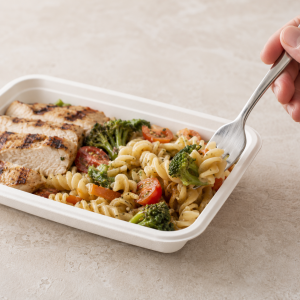
What happens when a tray is too shallow?
A very shallow tray can work well for pastries, sandwiches and dry snacks. But when the meal contains pasta, salad, vegetables or dressing, insufficient depth may create problems.
Food can move toward the edge when the customer carries the tray. Salad leaves may fall over the rim, and a fork can push rice or pasta outside the serving area when scooping.
Shallow trays therefore work best when the food is relatively stable and does not require much containment.
Can a tray be too deep?
Yes.
A deeper tray is not automatically more convenient. High walls may hide bakery products, make sandwiches harder to pick up and force a fork to enter the tray at an uncomfortable angle.
The last pieces of food may also become more difficult to reach, particularly in corners.
The best tray depth is not the deepest option—it is the depth that matches the food.
Karde’s open 7 Inch, 8 Inch, 8 × 6 Inch and 9 × 6 Inch bagasse trays are examples of formats that can be evaluated for different foods according to their dimensions and serving needs.
Does the Rim Affect How Easy Food Is to Scoop?
The rim does more than help keep food inside the tray. It can also support the movement of a fork or spoon.
Imagine eating rice or pasta. Many people naturally push the food slightly toward the side of the tray before lifting it with a fork. A properly designed edge can provide resistance and make this easier.
Three everyday actions are worth testing.
Scooping: Can a fork collect rice, vegetables or pasta without pushing them over the edge?
Cutting: Does the tray remain stable when cutting chicken, sausage or another food with a knife?
Reaching the last bite: Can food near the corners be picked up easily, or does the shape trap small pieces?
These details may sound minor, but they directly affect the customer’s experience.
How Much Empty Space Should a Meal Have?
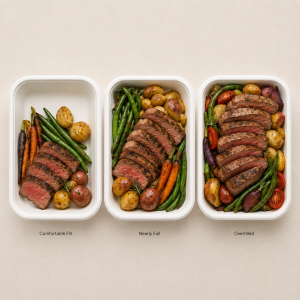
A common packaging mistake is assuming that a tray should be filled as completely as possible.
In practice, some empty space is useful.
Food needs what can be called working space—a small amount of open tray surface that allows customers to move utensils, reposition food and hold the edge without touching the meal.
If food reaches every side of the tray:
- A fork has less room to move.
- Cutting becomes more difficult.
- Sauces are more likely to reach the rim.
- Food can fall out when the tray is tilted.
- There may be no clean area for holding the package.
For this reason, a tray that technically “fits” a portion may still be too small for comfortable eating.
Restaurants should compare a normal fill level, a nearly full tray and an overfilled tray using the same meal before choosing a packaging size.
Why Food Shape Can Matter More Than Food Weight
Two meals of the same weight can require very different trays.
For example, 250 grams of pasta spreads across a serving surface very differently from a sandwich with fruit, even though the total weight may be similar.
| Food | Main eating consideration |
|---|---|
| Sandwich | Needs enough length and easy hand access |
| Pasta | Needs open space for fork movement |
| Salad | Benefits from depth to keep leaves contained |
| Pastries | Need visibility more than high walls |
| Rice meals | Need a stable base for scooping |
| Roasted vegetables | Need enough area for individual pieces |
This is why tray selection should not be based only on grams or milliliters.
Rectangular bagasse trays such as 8 × 6 Inch or 9 × 6 Inch formats can be useful when the menu contains elongated foods, several bakery items or a main product with a side.
Does a Rectangular Tray Make Some Foods Easier to Eat?
Rectangular trays can create a natural direction for arranging food.
A sandwich can occupy one side of the tray while fruit, salad or another side item occupies the remaining area. The customer immediately understands where each component is located.
This can work particularly well for:
- Sandwiches and rolls
- Croissants
- Bakery combinations
- Pasta portions
- Fruit and snacks
- Light grab-and-go meals
Instead of concentrating everything in the middle, a rectangular tray can organize food from one end to the other.
That does not mean rectangular trays are always better. The benefit appears when the tray geometry matches the food geometry.
When Do Compartments Make Eating Easier?
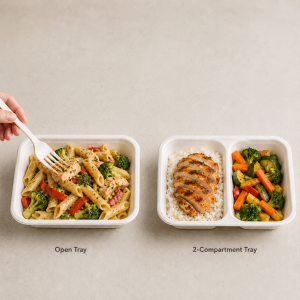
Compartments are useful when food separation solves a real problem.
For example, a Two Compartment Bagasse Tray can keep a main dish separate from vegetables or a side. A three- or four-compartment format can help organize complete meal sets.
Compartments are particularly useful for:
Rice and curry: The customer can decide when to mix the sauce with the rice.
Protein and vegetables: One component does not completely cover the other.
Main dish and side: Different textures can remain separated before eating.
Portion-controlled meals: Each food has a clearly defined place.
In these situations, compartments can make the meal more organized and easier to understand.
Can Too Many Compartments Make Eating Harder?
They can.
More compartments do not automatically create a better meal tray.
A pasta dish does not normally need three or four separate sections. Fried rice may be easier to eat from one open space. A large piece of chicken can become awkward if the compartment is too small for cutting.
A salad also benefits from room to mix ingredients, so unnecessary dividers may reduce usable space.
A useful principle is:
Compartments should solve a food-separation problem, not simply add more sections to the tray.
For some menus, an open bagasse tray provides a better eating experience than a highly divided one.
Can You Comfortably Hold the Tray While Eating?
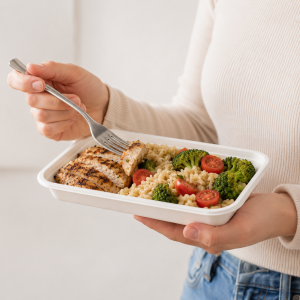
Not every customer eats at a table.
Food trays are often used at:
- Food courts
- Trade shows
- Festivals
- Weddings
- Outdoor events
- Standing receptions
- Catering buffets
In these situations, stability becomes especially important.
One-hand support
Can the tray be supported underneath with one hand while the other hand uses a fork?
Weight distribution
If all the heavy food sits at one end, does the tray tilt or flex?
Rim grip
Is there enough clean edge for the customer to hold without touching the food?
Flexing
Does the tray remain reasonably stable after the food has been added?
A tray that works perfectly on a table may feel very different when a customer has to hold it while standing.
Eating at a Table vs Eating on the Go
Different dining situations create different priorities.
| Eating situation | Important tray characteristics |
|---|---|
| Seated dining | Fork movement, cutting space and easy food access |
| Standing event | Stability, grip and balanced weight |
| Grab-and-go | Food organization and portability |
| Catering buffet | Easy carrying and immediate eating |
| Bakery or café | Visibility and easy hand access |
A café serving croissants has different tray requirements from a caterer serving rice, meat and vegetables.
This is why “one tray fits all” is rarely the best approach.
How Should Food Businesses Test a Tray Before Ordering?
A tray should be tested as something customers eat from, not only as something kitchens put food into.
Before placing a bulk order, food businesses can run a simple real-world test:
- Fill the tray with the normal selling portion.
- Use the real fork, spoon or knife provided to customers.
- Try to reach food in every corner.
- Cut a food item inside the tray.
- Carry the tray with one hand.
- Simulate standing while eating.
- Leave the food for 10–30 minutes and test again.
- Test the wettest, heaviest and oiliest menu item.
- Compare open and compartment formats where relevant.
- Ask several people to use the tray rather than relying on one opinion.
This type of test often reveals issues that are impossible to see from dimensions alone.
Which Bagasse Tray Format Fits Different Eating Styles?
Different formats can be evaluated according to the meal:
| Eating situation | Tray format to test |
|---|---|
| Sandwich or bakery item | 7 or 8 Inch open tray |
| Larger sandwich with sides | 8 × 6 or 9 × 6 Inch bagasse tray |
| Pasta or salad | Open tray with suitable depth |
| Main dish and side | Two Compartment Bagasse Tray |
| Complete meal set | Three Compartment Bagasse Tray |
| Several small meal components | Four Compartment Bagasse Tray |
The final choice should still be confirmed using the real menu because food shape, portion size and eating style may change the result.
Frequently Asked Questions
What makes a food tray comfortable to eat from?
A comfortable food tray provides enough depth to contain the meal, enough open area for utensils, a stable base and easy access to food around the edges and corners.
Is a deeper food tray always better?
No. Excessive depth can make food harder to see and reach. The best depth depends on the food being served.
Are compartment trays easier to eat from?
They can be when foods need to remain separated. For pasta, salad or mixed meals, unnecessary compartments may reduce useful eating space.
What foods work well in open food trays?
Sandwiches, bakery products, salads, pasta, fruit, snacks and many light meals can work well in an open tray when the dimensions match the portion.
Should restaurants test food trays before bulk ordering?
Yes. Testing the actual menu, portion size, utensils and dining situation provides more useful information than relying only on outside dimensions or capacity.
Conclusion
An easy-to-use food tray needs to do more than simply hold a meal.
It should contain the food, leave room for utensils, remain stable while being handled and match the way customers actually eat.
Tray depth, rim design, working space, food shape and compartments all influence the experience. A format that performs well for sandwiches may not be ideal for salad, pasta or a multi-component meal.
Before selecting an open or compartment bagasse tray, food businesses should test the product with the actual menu and eating situation. The most suitable tray is not necessarily the largest or deepest one—it is the one that makes the meal easier to serve, carry and eat.